Showing posts with label global. Show all posts

Sunday, April 8, 2018

Nigerian Fried Rice and West African Peanut Chicken


When my brother Josh comes to visit, text conversations like this one ensue.
Me: How would you feel about us making Nigerian food some time this weekend? I'm thinking curry fried rice and peanut chicken kebabs. 
Josh: Big fat yes on that.
And so we did. Since there are two recipes in this post, I'll keep my comments brief with these few observations:
  • I can't recall ever having curried fried rice. Or fried rice without soy sauce. I've been missing out.
  • In this global eating adventure, the dishes I've made from African countries have consistently been among my favorites. See my posts on Madagascar and Tunisia.
  • My house smelled incredible for hours after preparing this meal. We made it for a late lunch, and when we got back from house church at something like 9:00, a pungently spiced aroma greeted us when we came through the front door.
  • Honestly, I can't recall the last time I bought bouillon cubes, since I normally use Penzeys's soup base. But the writer of these recipes urged me to trust Nigeria, so I did. And Nigeria did not let me down.
  • If cooking both dishes as a meal, I recommend this sequence of prepping/cooking: 1) Cook the rice; prep the peanut mixture and rub it on the chicken. 2) Play a game of Pandemic while the rice cools and the chicken gets acquainted with its coating. 3) Prep the fried rice ingredients, fry the rice, and cook the chicken. If you're using a grill, then somewhere in there you'd need to prep your grill. 


Nigerian Curry Fried Rice
Adapted slightly from Global Table Adventure
Yield: 4 servings

Ingredients
1-1/2 cups long-grain white rice (uncooked)
2-3 Tbsp. oil (I used canola, and used more than 3 Tbsp.)
1 medium to large onion (yellow or white), small dice
2 cloves garlic, minced
1 Tbsp. curry powder
2 cubes chicken bouillon, crushed
1 bell pepper (yellow, orange, or red), small dice
8 oz. fresh green beans, small dice
1/2 cup corn kernels (canned, fresh, or frozen)
Salt, to taste

Directions
Measure rice into a fine mesh strainer and rinse well under cold water. Then cook according to package directions. Ideally, do this at least an hour ahead of time and, when the rice is finished cooking, remove the lid and fluff with a fork, then let it sit for a while to cool off and dry out a bit. If you made the rice the day before, all the better.

Now prep all your ingredients. We used corn kernels as a basic size guide for everything we chopped. I like to organize ingredients as I prep them. So the onions went on their own plate; the garlic, curry powder, and chicken bouillon went into a little condiment cup together; and the bell pepper, green beans, and corn shared another plate.

Heat 1 Tbsp. or so of oil in a large skillet or wok over medium-high heat.* Add the onion, and saute until softened and translucent. Add the garlic, curry powder, and bouillon and stir for just 30 seconds to a minute, then add the bell pepper, green beans, and corn. Continue cooking and stirring for a few minutes more, until the veggies are starting to soften, adding more oil as needed. Finally, incorporate the cooked rice, and keep on stir-frying until the rice is hot and a little browned, again adding more oil as needed. Taste and add salt if needed. Enjoy!

Note
*We used my 12-inch cast iron skillet, which I anticipated would not be big enough for the whole recipe. So we went with half the onions, half the seasonings, half the veggies, and half the rice, removed that to a serving bowl, then repeated the process with the other half of everything. And we started heating the chicken skillet about the time that the first half of the fried rice was done. 


West African Peanut Kebabs (Suya)
Yield: 4-6 servings

Ingredients
1-1/2 lbs. chicken or beef, sliced into strips*
1 cup roasted peanuts
1 Tbsp. grated fresh ginger
3 cloves garlic, minced
1 chicken bouillon cube, crumbled
2 tsp. paprika
1-1/2 tsp. onion powder
Cayenne pepper, to taste
Salt, to taste

Directions
Toast your peanuts in a dry skillet over low heat, just until they start to toast and smell amazing. Remove from heat (and from the hot skillet) and allow them to cool while you prep other ingredients. (You could skip this step. It was my addition because I love the extra flavor hit you get when toasting nuts.)

Blitz the peanuts in a food processor until they're crumbled/finely chopped, but be careful lest you end up with peanut butter. The ol' Magic Bullet did okay with this task, but not great. Combine the peanuts with the ginger, garlic, bouillon, paprika, onion powder, cayenne, and salt.

If you're feeling authentic, thread your strips of meat onto skewers, then press the peanut mixture onto the meat. If you're feeling lazy, dump the meat into a gallon zip bag along with the peanut mixture, and give it a nice massage so the meat is coated nicely. Either way, refrigerate the seasoned meat for at least 30 minutes.

Cook over medium heat--in a skillet or on a grill--until done, being careful not to move them around too much, as the coating will fall off pretty easily.

Note
*We used boneless, skinless chicken thighs; apparently you could also use ram.

Tuesday, January 2, 2018

Bangladeshi Chicken and Potato Curry


Whelp, my year started with a Bangladeshi meal, so I'd say I'm a fan of 2018 thus far. This meal comes from the Hot Bread Kitchen Cookbook: Artisinal Baking from Around the World, one of the newest arrivals to my cookbook library. It was through this episode of the A Couple Cooks podcast that I first learned of Hot Bread Kitchen, a bakery and training program in NYC that employs and trains immigrant and minority women to succeed in the professional food business. Through the program, these women gain marketable, employable skills and experience, in addition to training in English, kitchen math, and science. Everything on their menu comes from the home countries of the employees and graduates of Hot Bread Kitchen.

This cookbook features many of the breads of Hot Bread Kitchen, as well as things to eat or drink with said breads. Most recipes include a story behind the dish or the culture from which it comes, and sprinkled throughout the cookbook are spotlights of several Hot Bread Kitchen women. And these recipes come from all over the world, so in the span of a few pages you go from Ethiopia to Iran to India to Italy--and that's just in the leavened flatbreads chapter!

Hailing from the kitchen of a woman named Lutfunnessa, who taught political science in Bangladesh before moving to New York in the 90s, this curry recipe lands in the first chapter of the book, so it caught my attention early. Even after reading most of the rest of the book, when I thought about what I wanted to make first from the HBK Cookbook, my mind kept drifting back to the Bangladeshi curry and Bangladeshi flatbread (whole wheat chapatis). Besides, the paragraph at the top of the recipe says it's "perfect on a cold night"--and since it seems the entire U.S. is frozen right now, this curry was the perfect way to ring in the new year.

I served mine with the aforementioned whole wheat chapatis, which are also included in the cookbook, but you can definitely serve it with rice instead. The recipe is written with beef instead of chicken but, with the blessing of the paragraph at the top of the recipe, I used chicken thighs instead. This is a fairly simple dish to make, but it does require some time to simmer.


Bangladeshi Chicken and Potato Curry
Adapted slightly from Hot Bread Kitchen Cookbook (p. 38)
Yield: 3 servings

Ingredients
3 Tbsp. canola oil
1 to 1-1/2 lbs. boneless, skinless chicken thighs, cubed
Kosher salt and black pepper, to taste
1 small yellow onion (or half of 1 large), diced
2 cloves garlic, minced
1-inch piece of fresh ginger, peeled and minced
1/8 tsp. cayenne (1/4 tsp. for more heat)
1 tsp. ground cumin
1 tsp. ground turmeric
1/4 tsp. ground cinnamon
1/4 tsp. ground cardamom
1-1/2 cups water
2 large russet potatoes, peeled and cubed (approx 1-inch cubes)
Handful of cilantro, chopped
Cooked basmati rice or whole wheat chapatis (flatbread), for serving

Directions
In a medium to large pot, heat oil over medium-high heat. Season the chicken with salt and pepper, then add to the pot. Cook until the chicken is browned, stirring occasionally. Remove chicken to a plate.

Turn your burner down to medium and add the onion, garlic, ginger, and cayenne to the pot. If needed, add a splash of water to loosen any browned bits left behind by the chicken--there's great flavor there! Cook for another 10 minutes or so, until the onions are softened and starting to brown, stirring occasionally. Stir in a bit more salt while the onions cook. Add the remaining spices--cumin, turmeric, cinnamon, and cardamom--and stir for just a minute, to release the spices' fragrance.

Pour the water into the pot and add the chicken back in. Bring to a boil, then reduce the heat, cover, and simmer for about an hour. Check it every so often to give it a stir and add more water if it's getting dry (I checked every 20 minutes and never needed more water).

Now add the potatoes to the pot and keep on simmering (covered) for 20-30 minutes, until the potatoes are nice and tender. Mine were very soft after 30 minutes. Again, stir every so often, and add water if needed. Taste and add salt and pepper if needed. Sprinkle with cilantro, and serve with rice or chapatis.

Friday, December 29, 2017

Global Eats: A Year in Review

world map
Photo credit: “World Map – Abstract Acrylic.” Photo by Nicolas Raymond. Painting by Lara Mukahirn. Some rights reserved. Retrieved here.

About a year ago, I challenged myself to spend 2017 exploring more cultures through food. It's been a fun and scrumptious year! I've enjoyed the challenge of seeking out new recipes, techniques, ingredients, and flavor combinations from all over the world. Also, aiming for one country each month was just about perfect--it was doable and consistent.

And because bloggers are supposed to do end-of-year round-ups, here's a rundown of the foods I've gotten to experience this year, as well as some new ingredients and equipment that have found new homes in my kitchen.

Looking ahead to 2018, I plan to keep experimenting with different international cuisines! Near the top of my list: Bangladesh and Poland.

January: Peru

Menu and write-up are here
Peruvian Beef Kebabs (Anticuchos with Roasted Yellow Pepper Sauce)
Potatoes with Huancaina Sauce (Papa a la Huancaina)
Sarsa Salad
Crema Volteada

February: Tunisia

Menu and write-up are here
Chicken Kebabs with Currant and Olive Relish
Slata Mechouia (Grilled Salad)
Orange Almond Cake

March: Hungary (and kinda Romania)

Hungarian Tomato-Pepper Stew (Lesco) - and we served it over polenta, because apparently polenta is a common breakfast element in Romania.

April: Vietnam

Vietnamese Shrimp Noodle Bowl (Bun Tom Xao) - fresh, crunchy, and bursting with flavor.

May: Finland and Dutch West Indies

Finnish Pulla Bread with Apricots and Pistachios - one of the most beautiful things I've ever made. I was so proud of these glisteningly bronzed braids!
Dutch West Indian Chicken Kebabs (Boka Dushi) with Dutch West Indian Peanut Sauce - with most dishes, I have a pretty good idea of how they're going to taste. This one, however, combined so many ingredients that I wouldn't have thought to combine, that I truly didn't know what to expect from the finished dish. Happily, it turned out to be one of my favorite dishes this year. We served it with a side of sauteed plantains.

June

My job is crazy-busy every June, so I didn't officially try any new countries. But the Tunisian menu got an encore performance, and I vaguely remember trying a new Thai dish.

July: Madagascar and Ethiopia

Malagasy Chicken with Ginger (Akoho Sy Sakamalao) - another favorite this year, largely because it surprised me with how good the finished dish was despite the fairly simple ingredients and preparation technique.
Ethiopian Cucumber-Mango Salad

August

For the life of me, I can't remember what country (if any) I cooked in August. But I did try preserved lemons for the first time, and those are used a lot in north African and Mediterranean dishes.

September: Myanmar

Burmese Ginger Salad (Gin Thoke) - this salad had so much going on. It was strong on the ginger and lemon, crunchy from the cabbage, and filling thanks to the chickpeas and lentils.
Also some Pineappleade which is kinda generically Southeast Asian.
Also an encore of the Malagasy chicken.

October: Somalia

Somali Beef Stew with Spiced Rice (Bariis Maraq) - making this meal included mixing up a classic Somali spice blend, called xawaash, which was a key player in both the stew and the spiced rice. If you make this, do yourself a favor and don't skip the bananas. They seemed to me like an odd topping, but my favorite bites were ones that included banana. As a fun side note, this dish was part of a global food spread that my house church did in celebration of World Food Day.

November: Germany

Obatzter (Camembert cheese spread)
Bavarian Soft Pretzels

December: Spain

Rustic Spanish Bread (Pan Rustico) - simple and good. In light of the holidays, birthday, and being knocked out with a cold for a few days, something simple was all I could manage this month.

New Ingredients and Equipment

  • Aji amarillo - yellow pepper paste from Peru
  • Almond meal - sure, it's widely used here in the States, but Tunisia inspired me to use it for the first time
  • Hungarian wax peppers - mild spice level, and they were readily available at Walmart
  • Kitchen scale - this inexpensive but reliable scale is suuuuuper helpful with recipes with measurements written in grams and ounces rather than cups and teaspoons ... which happens often when using recipes that didn't originate in the U.S.
  • Orange blossom water - basically the elixer of the gods
  • Pistachios - though I never cared for them before, I used (and enjoyed!) them quite a bit this year
  • Pomegranate molasses - made my own; used in this Pomegranate Molasses Chicken
  • Preserved lemons - when my current jar runs out, I want to try making my own
  • Spice grinder - this year my eyes (and taste buds) were opened to the wonderful world of grinding one's own spices right before tossing them into a dish. Grinding whole cloves, peppercorns, and cumin seeds will give you much more punch than measuring out pre-ground spices. I use my Magic Bullet which I've had for awhile, and I've heard that a coffee grinder or a mortar and pestle work quite well.
  • Sumac - ground spice used a lot in Middle Eastern foods; bought at Cordell's; I'd eaten it before but hadn't cooked with it
  • Xawaash - Somalian spice blend featuring cinnamon, coriander, cumin, black pepper, cardamom, cloves, and turmeric; recipe is included in the Somali stew recipe above.

Wednesday, August 2, 2017

Ethiopian Cucumber-Mango Salad


In my last post you may recall that I had a little soapbox moment about lumping all African countries together instead of recognizing them as very distinct countries and cultures.

Well, apparently I have now accidentally lumped two African countries and cuisines into a single menu, despite my best intentions. As it turns out, the ambiguous "East African" salad that wouldn't commit to a specific country but inspired me to cook up some Malagasy food, is actually Ethiopian. While typing up the recipe, I did a quick search to see if Cooking Light had an online version of the Cucumber-Mango Salad recipe. They do. And the online version very clearly identifies it as Ethiopian. So there you go.

Ethiopia and Madagascar, I acknowledge your distinctness, honor you as two different countries, and appreciate your foods.

Ethiopia's Cucumber-Mango Salad was a win. The longer ingredient list made for all sorts of flavors and textures pinging around in my mouth. The cinnamon, cumin, and clove hint at Indian curry flavors, while the tomato, mango, and cilantro are reminiscent of Latin salsa. The cucumber and red onion add crunch, and the lime juice wakes everything up and ties it all together. Mine turned out a little mushier than the cookbook photo suggested, but the taste was stellar. If you're mush-averse, I'd suggest using firm tomatoes or leaving them raw.


Ethiopian Cucumber-Mango Salad
From Cooking Light's Global Kitchen cookbook
Yield: 6 servings

Ingredients
1 cucumber, thinly sliced (about 2 cups)
1-1/2 cups finely chopped red onion
1/2 tsp. salt

A drizzle of peanut oil (I used canola)
1 lb. tomato, chopped and seeded (ideally drained, too)
3 Tbsp. chopped peanuts (dry-roasted, preferably unsalted)
1-2 jalapenos, seeded and finely chopped*
1/4 tsp. ground coriander
1/4 tsp. ground cumin
Pinch of cayenne
Dash of ground cinnamon
Dash of ground cloves

1 garlic clove, minced
1-2 mangoes, peeled and diced (about 1-3/4 cups)
1 Tbsp. chopped fresh cilantro
1 lime, juiced

Directions
Toss the cucumber and red onion with the salt, and set in a colander to drain for at least 20 minutes.**

Heat a medium to large skillet over medium-high heat. Add the oil, followed by the tomatoespeanutsjalapenoscoriandercumincayennecinnamon, and cloves. Saute for just a few minutes, until the tomato is tender and warmed through (about 5 minutes tops). Remove from heat and allow to cool to room temperature.

In a medium to large bowl gently toss together the cucumber mixture, tomato mixture, garlicmangocilantro, and lime juice.

Notes
*If you can find red jalapenos, then do one red and one green. I used just one jalapeno, and the salad was very mild. Could have easily tossed in another and been totally fine.
**The recipe said to include the garlic at this stage, but I was afraid it would just fall through the holes in my colander. So I set it aside in a separate tiny dish with a sprinkle of salt.


Monday, July 31, 2017

Malagasy Chicken with Ginger (Akoho sy Sakamalao)


Note to self: onions that are simmered in a luscious amount of coconut oil until they're so soft they melt in your mouth ... are not photogenic. More important note to self: they're terrific for eating.

While flipping through reading like a novel the Global Kitchen cookbook, an East African Cucumber-Mango Salad recipe caught my eye but also presented a dilemma. You see, it reeeeally bothers me when people treat the entire African continent as a single country, culture, or people group. It's just wrong. So I was miffed that the recipe was associated with the broader region of East Africa rather than a specific country ... to the point that I almost wrote off the recipe on principle. But it sounded so yummy and summery! So I struck a compromise with myself: I'd find a main dish recipe from a specific country in East Africa, and make this ambiguous Cucumber-Mango Salad as a side dish.

The winner of that internet search was Akoho sy Sakamalao--literally "chicken and ginger"--a dish hailing from Madagascar. To be honest, the recipe sounded good but not amazing. The ingredient list is simple, the cooking technique un-fussy. But my first bite revealed the dish to be far greater than the sum of its parts. There's some kind of magic happening with the ginger-lemon-garlic rub, the caramelizing onions and bell peppers, the nutty coconut oil, and the bed of simple rice soaking up all those flavors.

All in all, a wonderful meal! The Akoho sy Sakamalao recipe is below, and the Cucumber-Mango Salad recipe is here. Thanks, Madagascar!


Malagasy Chicken with Ginger (Akoho sy Sakamalao)
Adapted from Global Table Adventure
Yield: 4 servings

Ingredients
3 cloves garlic, minced
1-inch piece of fresh ginger, grated
Zest from 1 lemon
4 chicken thighs (I used boneless, skinless, without the drumsticks attached)*
1/3 cup coconut oil**
1 orange bell pepper, sliced
1 onion, sliced
Salt and pepper, to taste
Cooked white rice, for serving

Directions
Combine the garlic, ginger, and lemon zest, and rub it all over the chicken. Cover (or put into a plastic zip bag) and refrigerate for at least 2 hours. Overnight or all day would be perfectly fine.

In a large skillet, heat the coconut oil over medium heat. Brown the chicken until it's a lovely golden color on both sides. When you add the chicken to the pan, your oil will probably go crazy. I recommend putting a lid on the skillet, but tilt it to let steam out, and pull the skillet off the burner to let the oil calm down a bit any time you need to mess with the food inside.

When the chicken is beautiful, take it out of the pan, and season it with salt and pepper. Add the bell pepper and onion to the pan, and saute until softened. Add the chicken back to the pan, lower the heat, and put a lid on (not tilted this time). Let it simmer for about 45 minutes, until the chicken is super tender. I gave the skillet a good shake/slide/jiggle every so often to keep things from sticking.

Cook your rice while the chicken and veggies are simmering.

Nibble a bit and add more salt and pepper if needed. To serve, spoon a good portion of rice onto your plate. Top with onion/bell pepper mixture and a chicken thigh. Scoop some of the sauce over the whole thing--the sugar from the onions and lemon will have caramelized nicely, and all that glorious flavor will be packed into your coconut oil sauce.

Notes
*The recipe on Global Table Adventure uses bone-in thigh quarters (leg and thigh both). I decided to go for just thighs in order to have smaller portions and less meat, and at the store I went into auto-pilot and got boneless skinless, though bone-in probably would have been more flavorful.

**I couldn't quite bring myself to eat an entire 1/3 cup of coconut oil by myself, so I ended up scooping it only sparingly over my plate ... which meant that a lot of that glorious caramelized flavor was wasted. If I make this again, I'd probably scale back to 3-4 Tbsp. coconut oil instead of a full 1/3 cup.


Tuesday, May 30, 2017

Finnish Pulla Bread with Apricots and Pistachios


Have you had the pleasure of watching The Great British Baking Show (a.k.a., Bake-Off)? If you like baked goods and you like seeing a more positive side of humanity, I absolutely recommend it. Unlike U.S. American food competition shows, the contestants and judges are actually genuinely nice to each other, and they genuinely seem to care more about having fun with their creative outlet than with winning.

Well, several months ago I watched all the seasons of Bake-Off that Netflix would allow, and though I was thoroughly wowed by every episode, I found myself most inspired by the enriched breads, as these bakers kept creating succulent doughs studded with fruit and spices and shaped into intricate braids and knots that shimmered with sticky sweet glazes. This past weekend I finally went for it!

Based on the numerous pulla recipes I read during the last 48 hours, pulla is a traditional Finnish bread. It's a yeasty cousin to brioche and challah; flavored with cardamom; generally shaped into a braid, a wreath, or buns; and traditionally served with coffee. Some recipes included fruit or nuts, while others were more basic. So I wound up making a more plain, traditional loaf and a more jazzed up loaf.


Finnish Pulla Bread with Apricots and Pistachios
Yield: 2 loaves/braids*
Source: I referenced many recipes but mostly followed the ingredients from Around the World in 80 Bakes and the process from All Recipes

Ingredients
6 Tbsp. butter, melted, at room temperature
1-1/2 cups milk (at least 2%; I used part 2%, part half-and-half)
4-1/2 tsp. active dry yeast (or 2 packets, 7 g each)
2 tsp. salt
6 Tbsp. sugar (1/4 cup + 2 Tbsp.)
3/4 to 1 tsp. ground cardamom**
700 g all-purpose flour (for me this ended up being about 4-2/3 cups)

Zest of 2 oranges
16 dried apricots, finely diced
40 g pistachios, finely chopped

1 egg

Directions
Melt the butter and allow it to cool to room temperature. Warm the milk to 110 degrees.*** Go ahead and measure out your flour into a smallish bowl. You'll add it in increments, so it's easy to measure once and then eyeball it throughout the different steps in the recipe.

To a large bowl add the milk, yeast, salt, sugar, cardamom, and about 1 cup of flour--enough to make a runny batter. Beat the batter until it's really nice and smooth. (For me, this was a couple of minutes on medium speed with my little handheld five-speed mixer.)

Add some more flour (1-2 cups) and continue beating until it's again smooth and elastic. If you're using a hand mixer like mine, aim for more like 1 to 1-1/2 cups flour. I added close to 2 cups, and it made the dough too thick--it just kept climbing up the beaters!--so I had to switch to beating by hand.

Now add the melted butter. Beat the dough some more, until the butter is fully incorporated and the dough looks smooth and glossy. Add the rest of the flour and keep on mixing until it's fully incorporated. If you have a good quality stand mixer, rejoice! If you don't, you'll get a good arm workout!

Now, lightly flour a clean countertop, and turn the dough out onto it. Invert your mixing bowl over the dough, and let the dough (and your arms) rest for 15 minutes. When those 15 minutes are up, knead the dough for a good 10-15 minutes, until it's nice and smooth.****

Remember your mixing bowl? Spritz it with a bit of cooking spray, put your ball of dough inside, turn the dough so all of it gets lightly coated with oil, and cover the bowl with a damp, clean kitchen towel. Let the dough rise in a warm, undrafty place until it's doubled in size, about 1 hour.

Punch down the dough. If jazzing up your bread, add your orange zest, apricots, and pistachios now. Knead them into the dough. Let it rest for another 5-10 minutes (on the counter is fine, covered with that damp kitchen towel you used earlier).

Divide your dough into 6 portions, as equal as you can get them. Roll each portion into a long rope, about an inch in diameter.

Gather up 3 ropes, and pinch them together on one end. Gently braid the 3 ropes together, and when you get to the end, pinch those ends together as well. Tuck both ends (top and bottom) under the braid, so you have a nice, tidy-looking loaf braid. Repeat this process with the other 3 ropes to make your second loaf braid.

Place braids on a greased baking sheet. Spray the tops with oil, cover with plastic wrap, and let rise for about 30 minutes.

Preheat oven to 400. Beat an egg really well, until it's super smooth. Remove the plastic wrap from the loaf braids and very gently brush some beaten egg over the loaves. Bake for 25-30 minutes, rotating the pan half-way through the baking time, until the loaves are browned, glistening, and look like they should be in a bakery display case!

Notes
*Initially I planned to make just one braid, but one recipe I read made an excellent point: if you're going to go to the trouble of making a homemade yeast bread--including all the kneading and rise time, you might as well make two or more loaves and have plenty to share. Your friends and coworkers will thank you.

**I saw widely varying cardamom measurements and settled on 3/4 tsp. When I nibbled some dough (I'm weird like that) the cardamom flavor was pretty subtle. So I added another 1/8 tsp. or so to the loaf I made with apricots, and kneaded it in along with the apricots, pistachios, and orange zest. That was still a nice amount of cardamom without feeling overwhelming.

***Some recipes I read said to scald the milk by bringing it to a near boil on the stove and then letting it cool to 110 degrees. I simply warmed mine in the microwave until it felt warm but not uncomfortably hot.

****I was expecting mine to reach a super smooth, satiny texture like I get with cinnamon roll dough ... but my pulla dough never got to that stage, even after 15 minutes. It was smooth, but the dough felt denser and heavier than I'm used to. I don't know if it's supposed to be that way, or if it got thrown off by some combination of my technique, the temperature and humidity of my kitchen, the flour measurement in the recipe I followed, or the general mood of the bread gods that day.


Sunday, May 14, 2017

Vietnamese Shrimp Noodle Bowl (Bun Tom Xao)


The first time I remember having Vietnamese food, it was at a pho restaurant in Los Angeles. My family got pho on my brother's recommendation, but I ended up ordering some other dish. Though I don't recall the name of the dish, I remember that it smelled gross but tasted pretty good. The gross-but-good culprit? Fish sauce. It truly does smell terrible. But when you mix it with something sweet, something acidic, and something spicy, it somehow transforms into this tasty thing that leaves you wanting more.

This dish comes from the Global Kitchen cookbook. And I'm happy to report that I could find all the ingredients locally. I've found fish sauce, rice vermicelli, and serrano peppers at both HEB and the north Walmart. If you don't see rice vinegar with other vinegars, look in the international and/or Asian section of your grocery store.


Bun Tom Xao (Vietnamese Shrimp Noodle Bowl)
Slightly adapted from Cooking Light, as seen in Global Kitchen cookbook
Yield: 4 servings

Ingredients
1/2 cup warm water
3 Tbsp. granulated sugar
1/4 cup fresh lime juice (about 2 limes)
1 Tbsp. rice vinegar
5 tsp. fish sauce
1-2 serrano chiles, thinly sliced

3 cups sliced cucumber (about 1 large cucumber)
4 cups green leaf lettuce, chopped
1/4 cup fresh cilantro leaves
1/4 cup torn fresh mint leaves
1/4 cup torn fresh basil or Thai basil leaves

5 oz. rice vermicelli noodles
1/2 cup peanuts, coarsely chopped (toasted if desired)
1/3 cup sliced green onions (1/4" slices) (about 2 green onions)
3 garlic cloves, finely chopped

2 tsp. cornstarch
1 tsp. dark brown sugar (I used light brown)
1/4 tsp. kosher salt
3/4 tsp. black pepper (or white pepper if you have it)
1 lb. shrimp, peeled, deveined, and tails removed (thawed if frozen)
Canola oil

Directions
In a two-cup measuring cup or small bowl, combine warm water and sugar, stirring until sugar dissolves. Add lime juice, rice vinegar, fish sauce, and serranos. It's going to smell seriously funky, so cover it with plastic wrap to keep that funk at bay, and set aside while you prepare the rest of the meal.

Peel cucumber if it's bitter. Cut into quarters lengthwise, then slice thinly. Toss with the lettuce, cilantro, mint, and basil.

Cook the rice vermicelli according to package directions. Rinse very well in cold water, and set aside to drain well. These noodles are super starchy, so if they're sitting for very long, give them another good rinse if they start to get sticky.

While the noodles are cooking, toast your peanuts, if desired, and allow them to cool before chopping. Slice your green onions and chop your garlic.

Combine cornstarch, brown sugar, salt, and pepper in a bowl. Add the shrimp and toss to coat well. If you have a wok, now is its time to shine. Otherwise, a large skillet will do quite nicely. Heat your wok/skillet over high heat, and add a swirl of canola oil. Add the shrimp to the pan, and cook until they start to develop a nice sear. When they're almost done, add the green onion and garlic, and stir-fry for about 30 seconds to 1 minute more. Remove from heat.

To serve, put a generous portion of the lettuce mixture in the bottom of each bowl. Top with noodles, shrimp, and chopped peanuts, and about 1/4 cup of the fish sauce-lime mixture.

Notes

  • I've also made this with boneless, skinless chicken thighs, chopped into small, thin slices about the size of medium shrimp. And I actually liked it better with the chicken. If you use chicken, prepare and cook it the same way; you'll just need to cook it a bit longer than the shrimp.
  • When I made this for just myself, I used only 1 serrano chile. When I made it with a friend I put 1 serrano in the sauce and sliced the other for an optional addition at table.


Thursday, April 6, 2017

Hungarian Tomato-Pepper Stew (Lesco)

Have you ever had stew for breakfast? As of a few weeks ago, I have!

When my brother came to visit last month, I basically forced him to join in my international cuisine challenge. We settled on breakfast and decided to go with a European country we're less familiar with. 20 minutes of Googling recipes later, and we settled on Hungarian breakfast stew, served over creamy polenta (which is, apparently, a common breakfast element in Romania), with a fried duck egg on top (because I'd just bought duck eggs from some friends, and we were excited to try them).

I'm seriously slacking in the photography department lately, mostly because I've been sharing meals with friends instead of eating alone. Which is an excellent thing for me, but it means I don't have a lovely photo to share with you. Sorrynotsorry.

Hungarian Tomato-Pepper Stew (Lesco)
From The Spruce
Yield: 4 servings (see notes)

Ingredients
1-2 slices bacon
1 Tbsp. oil
1 medium onion, thinly sliced
1 pound of peppers, sliced into 1/4" strips - use Hungarian wax peppers if you can find them, or banana, Italian, or green bell peppers, or some combination thereof
4 medium or 3 large tomatoes, peeled and chopped
1-1/2 tsp. sugar
1-1/2 tsp. salt
1 Tbsp. sweet Hungarian paprika

Directions
In a large skillet, cook bacon according to package directions. Remove bacon to a plate to cool, but leave all that tasty grease in the skillet.

Add in the oil and onion, and cook for about 5 minutes on low heat. Add pepper(s) and continue cooking for 15 more minutes. Add tomatoes, sugar, salt, and paprika to the skillet, and let it cook for 25-30 minutes, stirring occasionally, until it looks and feels like a chunky tomato sauce.

Meanwhile, crumble the bacon after it has cooled; stir it into the dish when it's close to being done.

Notes
  • This made 4 moderate to generous servings if served with polenta and a fried egg. If you're not making accompaniments, then this recipe may only give you 2-3 servings.
  • I went to the store fully expecting to be stuck with green bell peppers, but they actually had Hungarian wax peppers! The sign said they're medium-hot, so I decided to get one green bell pepper to bring down the heat level, and used wax peppers to make up the rest of the pound. The dish didn't taste super spicy, but I was coughing something awful while Josh was cutting the wax peppers.


Tuesday, March 14, 2017

Flavor Trip to Tunisia

Years ago, when a Food Network Star contestant was asked to tell viewers what harissa is, he responded, "It's the devil's toothpaste!" From that first moment of learning of this spicy chili paste's existence, I was afraid of it. But I kept seeing it pop up in magazines and food blogs, and while the fear lingered, I also always felt drawn to it, because its name and my name are almost the same.

Well, after exploring Peru's cuisine in January, I wanted to hop over to a country in Africa next ... and since harissa hails from Tunisia, I decided it was time to conquer my fear of the stuff. I looked at prepared harissa paste on Amazon, and even found this excellent article on The Kitchn about how to make your own harissa paste, using different kinds of chilies for sweeter, smokier, or spicier flavor profiles. And suddenly, I could find very few Tunisian recipes using harissa paste, and even fewer (none?) that used enough to warrant making a whole batch of harissa paste myself.

So harissa got pushed to the back burner once again, but the Tunisian idea stuck. Here's what I made a few weeks ago:
  • Tunisian Chicken Kebabs with Currant and Olive Relish - This dish packs some serious flavor, bringing together sweet currants, briny olives, mild peppadew peppers, and smoky roasted red bell pepper. Since peppadew peppers were nowhere to be found in the grocery stores I searched, I substituted sweet cherry peppers with excellent results. And I cooked the chicken in a cast iron skillet on the stove. I was a bit concerned that the relish and marinade would be too puckery and briny, but it turned out very nicely balanced with the sweetness of the currants and the earthiness of the roasted red bell pepper.
  • Slata Mechouia (Tunisian Grilled Salad) - Versions of this dish showed up a lot in my online searching for Tunisian recipes, which leads me to believe it's pretty authentically Tunisian. You grill/roast/char a bunch of veggies, chop everything up nice and fine, throw in some spices and olive oil, and top with olives and hard-boiled eggs. Most recipes also recommended topping it with canned tuna, but I left that off. It's kind of like a thick, chunky, not-real-soupy-at-all salsa. I thoroughly enjoyed it and would definitely recommend that you give it a try. I could see potential for spooning this salad over eggs or serving it with hummus and pita.
  • Tunisian Orange Almond Cake - Okay, I don't generally like cake all that much, but this cake was stellar! The batter is nutty, sweet, rich, and laced with orange and lemon zest. And if that wasn't tasty enough, it's drenched in a syrup made from sugar, cinnamon, clove, star anise, more orange and lemon, and orange blossom water. Although the orange blossom water makes the cake feel a bit magical, you could leave it out and would still have a scrumptious dessert. You can even underbake your cake and have it completely fall apart on you so you're quite literally left with an ugly pile of cake pieces, and it will still be superb. (Not that I know that from personal experience.) The recipe calls for caster sugar, which I made myself by taking granulated sugar for a spin in my food processor. You want it to be finer than granulated sugar but coarser than powdered sugar. Also, the recipe is all metric and weight measurements, which inspired me to finally give in and buy a kitchen scale. I got this little guy for $12, and he did great!

Monday, February 13, 2017

Orange Blossom Iced Tea

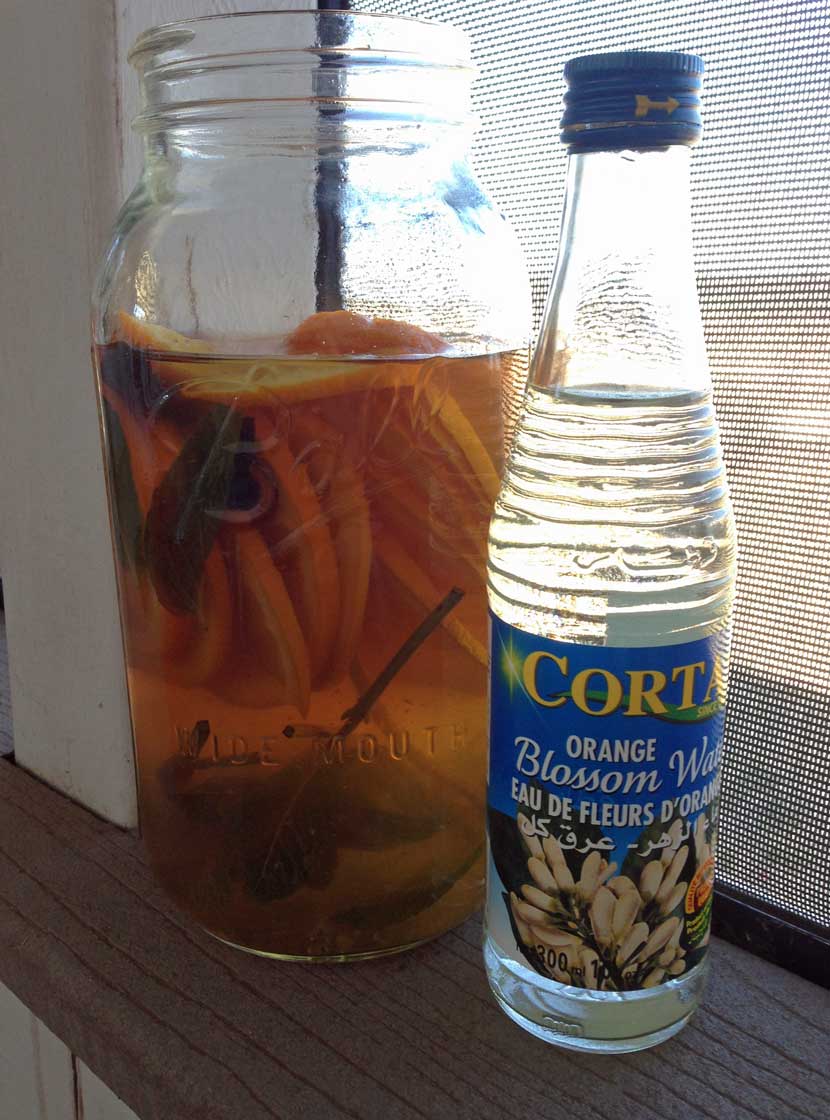
I'd like to introduce you to my new friend Orange Blossom Water. She's dainty yet mighty, mysterious and strong.

Throughout the Honey and Co. cookbook, I kept noticing recipes that called for orange blossom water, and I kept feeling disappointed because I doubted I'd be able to find it in any stores here. Happily, there's this thing called Amazon, and they sell basically everything, including orange blossom water.

This tea tastes like something Lady Galadriel would sip on a hot summer day.


Orange Blossom Iced Tea
From Honey and Co.: The Cookbook
Yield: 1/2 gallon

Ingredients
6 cups water
2 Earl Gray tea bags
1 cup sugar
1 cup water
1 Tbsp. honey
2-3 tsp. orange blossom water
1 orange, sliced
4 sprigs fresh mint
Additional mint and orange slices for garnish (optional)

Directions
Bring 6 cups water to a boil. Remove from heat, add tea bags, and steep for 15 minutes. This seemed like waaay too long, but I trusted the recipe, and it turned out beautifully.

While the tea steeps, make a simple syrup: Combine sugar, 1 cup water, and honey in a small saucepan. Bring to a boil, then reduce heat and simmer for a couple of minutes, until sugar and honey are fully dissolved. You will now have about 1-1/2 cups of simple syrup, and you'll need only 1 to 1-1/4 cups of it for this recipe.

When the tea is done steeping, discard the tea bags. Pour the tea into a heat-resistant jug or jar, such as a 1/2-gallon mason jar. Add 1 to 1-1/4 cups simple syrup (see notes), orange blossom water, orange slices, and mint sprigs. Cover and refrigerate until fully chilled.

Serve over ice, with additional mint and orange slices if desired.

Notes
  • I used 1-1/4 cup simple syrup, which is what the recipe called for. The resulting tea was very sweet, though not unpleasantly so, especially if you like sweet tea. Next time I'll probably scale back to just 1 cup of simple syrup.
  • If this tea sounds yummy but it's not feasible for you to get orange blossom water, don't let that stop you from making it! I imagine this would still be lovely and refreshing without the orange blossom water. Steeping some culinary lavender buds with the tea could be an interesting way to add a floral element.

Monday, January 16, 2017

A Flavor Trip to Peru

First up in my quest to try a new country's food every month this year: Peru!

I'd had Peruvian food only once before that I can recall: in a restaurant in Washington D.C. while on vacation a couple of years ago. I absolutely loved it, so was delighted to find multiple Peruvian recipes in Global Kitchen: The World's Most Delicious Food Made Easy, which my parents gave me for Christmas.

This meal introduced me to a new ingredient--aji amarillo paste--which I thankfully found on Amazon. It's made from a medium-hot yellow chili pepper which is very common in Peru. When I tasted the paste on its own, I worried that the dishes using it would be too hot for my taste, but that wasn't the case at all. It brought a nice flavor and a bit of heat, but nothing on my plate felt too spicy. Here's a rundown of our menu!

Peruvian Beef Kebabs (Anticuchos with Roasted Yellow Pepper Sauce) - These beef kebabs are marinated in red wine vinegar, aji amarillo, cumin, and turmeric. Then you dust them with parsley and more of the same spices, grill them (or cook in a cast iron skillet like I did), and dip them in this beautiful sauce made from roasted yellow bell pepper, green onions, white vinegar, oil, lemon, cumin, aji amarillo, turmeric, and garlic. This recipe actually calls for ground aji amarillo; since I bought paste instead of powder, I simply used the aji amarillo paste in the marinade and sauce. For the spice rub, I subbed equal parts regular paprika and smoked paprika. This was my favorite dish of the night.

Potatoes with Huancaina Sauce (Papa a la Huancaina) - This dish was the most unlike anything I've ever had before. To serve, you cover a platter with a bed of shredded lettuce, then top with boiled, peeled potatoes (gold or blue), and drizzle with a sauce made from roasted red bell pepper, sauteed onion and garlic, evaporated milk, aji amarillo paste, queso fresco (cheese), olive oil, and salt. But wait--there's more. On top of that you arrange wedges of hard-boiled eggs and a sprinkling of black olives. Potatoes are big in Peruvian cuisine, and this particular dish comes from the Peruvian highlands (Huancayo). I couldn't find the exact recipe I used online, but this one is fairly close to what I cooked from Global Kitchen.

Peruvian Sarsa Salad - My guests and I couldn't decide whether this was supposed to be a side dish eaten separately, or a relish eaten with a meaty main dish. Fortunately, it seemed to work both ways. It added a bright, fresh, crisp element to our plates. It was made from red onions, radishes, lima beans, queso fresco, roasted red bell pepper, and fresh cilantro and mint, all tossed in a light dressing of fresh lemon juice, olive oil, garlic, salt, and pepper. I was worried that it would be overpoweringly oniony, but it actually was really nicely balanced and lovely. I used extra lima beans in place of hominy, queso fresco instead of feta or farmer's cheese, and some red bell pepper I roasted myself instead of using bottled.

Crema Volteada - For dessert, I made this Peruvian flan. I found several variations online (surprise, surprise), including one that incorporated pureed cooked quinoa, which sounded intriguing. I landed on this one which seemed more basic. For me, it was the weakest link in the menu--the texture was a little off (probably my doing), and it was the least adventurous element since I've had flan plenty of times before. However, in terms of work and time management, it was perfect--it could be made the day before, which was especially nice since there were so many different elements to prepare in the other dishes.

Tuesday, January 3, 2017

Pomegranate Molasses Chicken + Bulgar Wheat Salad with Currants and Mint

One of the things I love most about food is that it's communal. Sure, we need it for sustenance. And it's a fun creative outlet. But more than that, I love how it connects people.

When our friends have babies, we eagerly bring them food and share their joy. When someone dies, we bring food to their loved ones, sharing their pain. When we want our coworkers to like us, we take baked goods to the office. When there's cause for celebration--a graduation, a wedding, a birthday--we throw a party with snacks at the very least and quite possibly a full banquet. When we want to get to know someone better, we find a time to eat together.

Food connects us.

This week I've been thinking about Laura. She entered my life as my brothers' friend and my close friend's cousin, and she remained in my life as my friend. Laura died this week. She'd been battling cancer for some time now, and on Sunday I woke up to the news of her death. Though we rarely saw each other after I moved away for college, whenever I did get to spend time with Laura, she always had this peaceful, comforting, welcoming, nurturing presence about her. She always made me feel like I belonged in whatever group we were in (often a struggle for me). She loved people well. She brought so much beauty to this world.

I wish I could take her family a meal.

On the day Laura died, I made this meal which felt exotic and beautiful. Perhaps because cooking is comforting, and I needed that on a day dampened with death. Perhaps because the act of preparing and eating food made me feel somehow connected to the people all over the world who grieve Laura's passing. Perhaps because it was a small way to bring a little beauty back into the world.


Pomegranate Molasses Chicken and Bulgar Wheat Salad with Currants and Mint
Adapted from Honey and Co.: The Cookbook by Itamar Srulovich and Sarit Packer
Yield: 2-4 servings depending on the size of your appetite and your chicken thighs

Chicken ingredients
1 clove garlic, sliced
1/4 to 1/2 green chili, sliced (I used 1/3 of a jalapeno, seeded)
Scant 2 Tbsp. pomegranate molasses (see notes)
1/2 Tbsp. canola oil
1/4 tsp. freshly cracked black pepper
4 boneless, skinless chicken thighs
Canola oil, for pan frying
Salt and pepper, to taste

Bulgar salad ingredients
3/4 cup bulgar wheat
1/4 tsp. salt
1/2 tsp. olive oil
1/2 Tbsp. pomegranate molasses
1/4 cup shelled pistachios, toasted and chopped
1/4 cup dried currants (see notes)
2-4 Tbsp. fresh pomegranate arils
Generous 1/4 cup chopped fresh mint
1/4 to 3/8 cup chopped fresh parsley (a couple handfuls)
Additional pistachios (roasted and chopped), pomegranate arils, and mint to sprinkle on top

Directions
Marinate the chicken: In a gallon sized zip-top bag, combine garlic, chili, pomegranate molasses, canola oil, and black pepper. Add chicken thighs, then squoosh everything around so the marinade coats the chicken well and the garlic and chili slices are pretty evenly dispersed. Seal the bag and chill in your fridge for 2 hours, or up to 2 days.

Cook the chicken: Preheat oven to 400. In an oven-proof skillet (cast iron works great), heat a glug of canola oil over medium heat (on the stove). When the skillet is hot, add the marinated chicken thighs, smooth side down. Season with salt and pepper (to taste) then don't touch them for 2-3 minutes. Let them get nice and golden! Turn the chicken, let that side brown for a couple of minutes, then transfer the skillet into the preheated oven. Cook for 12 minutes or until chicken thighs are fully cooked.

Prepare the bulgar salad: Cook bulgar according to package directions, adding the 1/4 tsp. salt and 1/2 tsp. olive oil. (I tried the more traditional method of pouring boiling water over my bulgar and covering it for 5 minutes, but mine was still crunchy after 10 minutes, so I resorted to zapping it in the microwave. Always before I've used the stovetop method which worked much better for me.) Fluff with a fork, then add the pomegranate molasses and continue tossing with a fork. Add all the rest of the salad ingredients--pistachios, currants, pomegranate arils, mint, and parsley--and toss to combine. Taste; add salt and pepper if needed.

I followed Itamar and Sarit's recommendation for serving: scoop some bulgar wheat salad onto your plate, top with a chicken thigh or two, and sprinkle with some extra pistachios, pomegranate arils, and fresh mint.

Notes
  • In theory, you can buy pomegranate molasses. But I couldn't find any, so I improvised and made my own! Basically you just simmer pomegranate juice, sugar, and fresh lemon juice until it thickens and reduces. I used Alton Brown's ingredient ratios and looked to Tori Avey's extra detail in the instructions.
  • If you're a fellow Abilenian and know where to get pomegranate molasses locally, please share your wisdom! I looked at Market Street and HEB, Drug Emporium and Cordell's were closed, and Natural Grocer's didn't answer when I tried calling to see if they carried it. Also orange blossom water for future recipes from this cookbook.
  • Currants can also be tricky to find here, but I found some in the bulk bins at Market Street. One of my friends has found them at Natural Grocers as well.
  • I cheat and buy the pomegranate arils that come in a little cup in the produce section.
  • As long as you plan ahead on marinating the chicken (and making the pomegranate molasses if needed), this could easily be a weeknight meal. It felt really fancy, but it doesn't involve any fancy techniques, and it came together pretty quickly once the pom molasses was made. Also, leftovers reheated well.


Monday, January 2, 2017

2017 Food Goals: Global Edition

If you've followed my blog for a while, you may recall that for several years I've set food goals for myself at the beginning of each year (but skipped 2016). The goals usually involved trying a new ingredient (like tomatillos or lavender) or dish (like panna cotta or stovetop popcorn). This year I'm challenging myself to cook more foods from other countries and cultures.

I want to be neither too restrictive nor too loosey-goosey with myself, so here are some basic parameters:
  • Try a new country/cuisine at least once a month.
  • Aim for countries whose cuisines I'm less familiar with. This means Italian, Mexican, Greek, and Chinese are out. Probably French, German, and Irish as well. 
  • Try to hop around from continent to continent. For instance, try something from Belize one month, Tunisia the next, Cambodia the next, Ukraine next, and so on. 
  • Invite friends over to share at least some of the meals with me, but don't get stuck on that. Sometimes it's more feasible to make pomegranate molasses chicken for myself on a random weeknight than to spend a weekend cooking up a feast and roping some friends into helping me eat it.
Speaking of pomegranate molasses chicken with bulgar wheat salad ... that happened last night.

pomegranate molasses chicken with bulgar wheat salad

Finally, let me leave you with some resources I'm sure I'll be using throughout the year.
  • Honey and Co. by Itamar Srulovich and Sarit Packer - This cookbook is chock full of Middle Eastern recipes, personal anecdotes, and good humor. (For instance, the recipe for Mushroom and Cumin Sfiha ends with "Do not offer your guests seconds--squirrel away any that is left over for the next day; it'll still be delicious.") The book was entertaining to read, and I could easily spend the year cooking through this cookbook alone.
  • Global Kitchen by Cooking Light and David Joachim - This one covers a smattering of dishes from regions throughout the world, so it'll be a good launching point for my little challenge to myself. Most recipes include a few sentences about the dish, the culture from which it hails, and/or a word about traditional techniques or modern tweaks.
  • Wild Spice by Arun Kapil - This book may be a little harder to use exclusively for my 12 countries in 12 months challenge because many of the recipes don't include information about the country or region that birthed it. Nevertheless, his recipes draw on spices and ingredients from around the world, so I'm still optimistic it has a place in my cooking repertoire this year, even if not specifically as part of my 12 in 12 challenge.
  • globaltableadventure.com by Sasha Martin - She challenged herself to cook something from every country in the world, and her site now holds over 650 recipes resulting from that challenge. Check out her Map Room page; click on a country and find all her posts and recipes from that country. She also has a page with a roundup of holidays from around the world, with recipes to go with them. Impressive! I'm trying to keep myself from exploring this site too much lest I paralyze myself with the sheer magnitude of options available. 

Saturday, February 11, 2012

Lamb, Apricot, and Olive Tagine

Back in September I bought some ground lamb on a bit of a whim, then couldn't settle on a recipe special enough to use said lamb (it's not cheap, you know). So into the freezer it went, and there it stayed until last week when I discovered this Slow-Cooker Lamb, Apricot, and Olive Tagine recipe from Real Simple. I'd never heard of tagine, it sounded like a really interesting combination of flavors, and I thought that using a slow cooker might be good in case the lamb was freezer burned.

Not the most photogenic dish, but very tasty!

To my surprise, the meat was not freezer burned (points for HEB packaging!). And the flavors were, in fact, interesting and incredible! I also just Googled "tagine" (also "tajine"), and it's a Moroccan dish named after the unique pot it's traditionally cooked in. There's also Tunisian tagine, but it's very different and resembles a frittata. Who knew?


I followed the recipe almost exactly, though I used ground lamb rather than 1-inch pieces. I also decreased the olives a tad since green olives aren't my favorite. And I left out the pistachios.

The original recipe says it serves 4, but you can easily do smaller portions and get more servings out of this. In fact, it's pretty rich, so I've been eating portions that are probably about half the size that Real Simple intends.  Smaller portions also helps make it more nutritious since this is not the lowest-calorie dish out there.


Slow-Cooker Lamb, Apricot, and Olive Tagine
Copied word-for-word from Real Simple

1 1/2 pounds lamb shoulder, trimmed and cut into 1-inch pieces
4 carrots, cut into 1-inch pieces
1 medium onion, chopped
1/2 cup dried apricots, halved
1/2 cup pitted green olives
2 cloves garlic, chopped
2 tablespoons all-purpose flour
1 teaspoon paprika
1 teaspoon ground cumin
1/2 teaspoon ground cinnamon
1/2 teaspoon ground ginger
kosher salt and black pepper
1 cup couscous
chopped pistachios, fresh cilantro leaves, and lemon wedges, for serving


In a 4- to 6-quart slow cooker, mix together the lamb, carrots, onion, apricots, olives, garlic, flour, paprika, cumin, cinnamon, ginger, 1 teaspoon salt, ¼ teaspoon pepper, and ½ cup water.

Cover and cook until the lamb and vegetables are tender, on low for 7 to 8 hours or on high for 4 to 5 hours (this will shorten total recipe time).

Ten minutes before serving, cook the couscous according to the package directions. Serve the lamb on the couscous with the pistachios, cilantro, and lemon wedges.